Portfolio

Missing the Mark
Silver Gelatin Prints with Screenprint, 42x42 each, 2023
This series explores biases and assumptions where the viewer interprets marks based on context. The marks come from the Japanese grading system. Different marks denote correct, wrong, close, and perfect. To a western audience the meanings of some marks may be obvious, some may seem meaningless, others may actually mean the opposite of what is expected. These are the first enlargements I have done at this scale in a darkroom and they were a learning experience. I have essentially evaluated this learning experience by grading it. Only by recognizing the context of the marks can the viewer discern the true meaning of the marks. So for those that fail to contextualize the information they will be “Missing the Mark”

Bento Boxes
Custom Screen Printed Japanese lacquered bento boxed with PVC food and video, 2016
One of the results of the nuclear accident in japan was the contamination of Japanese agricultural products. On one hand japan has a very highly developed food culture. On the other despite the emphases on quality contaminated food didn’t seem to faze many people.

Exponential Pattern
Wallpaper Antique Stove Lightswitch etc, 180x96, 2009
I combined the idea of a visual pattern with the repetitious cyclical behavior of U.S. politics. I focused specifically in the area of energy policy. The pattern of stock traders, industry smoke stacks, and oil pipelines all intersecting the capital building repeat over and over again. The visual here mimics reality, and just as in reality the viewer can extrapolate that the pattern continues endlessly. There is a possibility of breaking this cycle. That’s why there is another pattern. The pattern is similar to the other but it replaces all the negative parts. The new pattern showing through from underneath suggests that over time the old pattern can be stripped away leaving only the new pattern behind.

Supply and Demand
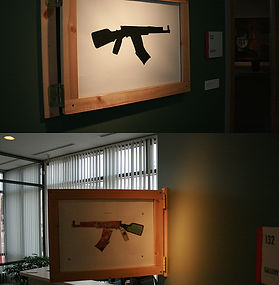
Woodcut Print on Wooden Frame, 144x88x18, 2007
The goal of billboards and advertising in general is to make something appear to be something other than what it is in reality, i.e. to make luxuries appear as necessities. This piece is my attempt to reverse engineer that principle and make a sign that showed what something really was instead of the illusion. The viewer first sees a gas pump and as they walk by the piece the image transforms into a gun. The truth is a gas pump is like a gun both physically and metaphorically. They are instruments at the base level by which power is gained and maintained. Guns can also represent many things such as violence, aggression, and coercion. Lobbyists are most certainly aggressive in the area of our nation’s legislation and policy. Shell oil's dealings in Africa is definitely an example of how violence can be perpetrated by business interests. Showing the gas pump as a gun along with the title "Supply and Demand" illustrates both the complex interactions that occur at the global level in the world of gaining and maintaining access to this resource, but also the lack of choice given to the consumer on whether or not to use this product.

81, 01, 82
Woodcut Print, 90x88 each, 2006
A continuing series of faces; passport style photos where the facial features have been replaced by numbers. The face contains the most information about individual recognition. This information was simply replaced with numbers; just as our identities have effectively been replaced by numbers. The numbers are the country calling codes of the individual’s home country. Social security numbers, driver’s license numbers, passport numbers, zip codes, phone numbers, and more are all used as forms of identification. To steal another’s identity, one need not impersonate that individual, but simply use the victim’s numbers. There is a great irony in that personal information has become so impersonal.

Hair of the Dog
Woodcut Prints, 30x44, 22x30, 15x22, 2016
The economic indicators used to assess our recovery are the same things that caused the financial collapse of 2007. The powers that be (both political and financial) are pushing for higher housing prices, larger consumer debt, and a stock market bubble. Our leaders are like alcoholics going for a morning drink after a hard night, addicted to the wrong decisions, Just trying to get back that high while disregarding the long term.

Fukushima Peaches.
Screen Print on Fabric, 118x79 in, 2012
After the nuclear accident in Fukushima farm products from the affected region contained cesium and other radioactive isotopes. Rather than removing them from the market the government instead promoted the products nationally. Peaches from Fukushima are known for being exceptionally sweet and were highly prized, and were even given as gifts.
In response to this, I went to a small local grocery store in japan and took photos of Fukushima peaches for sale and I used the images to screen print japan made out of glow in the dark Fukushima peaches.

Where the Day Goes
Wood Trash Cans LCD Screen, 20x20x30, 2008
By unobtrusively integrating video in the bottom of trash cans the viewer is drawn into the object. the viewer first notices the trash can, then sees video at the bottom of the can playing an endless loop of repetitive tasks. it is not obvious at first that the video is looping endlessly. the viewer watches for a while and waits with the expectation that something is going to happen. the driver will get closer to land, the stack of paperwork will get smaller, etc. But this never happens tasks occur endlessly, and this leads the viewer to realize it is literally and figuratively their time at the bottom of the trash cans. So much more time and labor is needed outside of the normal work day in order to perform one’s job. If we think about our day, we tend to think about the small percentage of productive time. Long spans of wasted time seem to be compressed in our memories. Where the Day Goes is my attempt to move the viewer to be aware of the tasks soaking up much of their lives and how those tasks revolve around their work day. The counter productivity that goes along with meetings about meetings, constant emails and memos, and other results of micro management are all part of being a cog in a bureaucracy.

Fireplug Cross
Mokuhanga (Japanese Style Woodcut Print), 79x157, 2007
The piece uses the dual meaning of the cross to illustrate that we both worship technological advances which are also burdens. The size and orientation of the work carved from a split tree evokes awe. The cross, as a symbol of Worship, is a familiar concept but we also refer to burdens in our lives as crosses to bear. By making a fire hydrant into a cross, I am taking a part of our modern life demonstrating that it, like everything, has a cost. We are so caught up in our technology, boasting of its time saving attributes while we are actually busier than ever. The cost of technology is money and the cost of money is time. We seem to think we are proactive, but our current technological advances are often solutions to problems caused by our previous technological advances. Not to mention that creating these advances and maintaining them comes at a high cost. There are many costs involved in having operational fire hydrants: making them, installing them, maintaining them, and training people to use them. For this cost, some of our time and labor must be surrendered. We must recognize how modern living has a higher cost than we realize and that we might want to reconsider our worship of it.

Disposable Planet
Woodcut Print, 44x90 each, 2006
This is a cigarette spinning as it is snuffed out. On the filter is the globe. So it is both the world spinning and the planet revolving. It seems that more and more of what we make is disposable. Poorly made, cheaper to produce than to repair, intentionally disposable products are on the rise, and some things are even designed to break after only a few years. Every, can, jar, and toothpick we take from this planet is valuable, But we have set up a system where it is cheaper to ship things around the world than to make them well locally. The world, it seems, is as disposable as a cigarette.

Butterfly Effect
Woodcut Print, 88x30, 2015
In 2012 scientists discovered mutations in pale grass blue butterflies in areas affected by the Japanese nuclear accident. It turns out that when the insects fed on plants that were irradiated it altered their DNA. The butterflies who’s DNA was altered sometimes did not show any physical signs but, abnormalities got worse with each successive generation. Hence the title “Butterfly Effect”
The piece is narrative, the first three frames show a pale grass blue butterfly landing on a dandelion stalk, and the fourth frame shows all three of the previous frames in silhouette forming the nuclear fallout symbol.

Plan A
Woodcut Print, 44x60, 2010
two figures in white gloves and tuxedos mirror one another crank starting chainsaws. the figures dress is reminiscent of turn of the century robber barons or modern day Japanese politicians. And they essentially represent those same roles and functions in our society. our leaders both of industry and government seem to be locked into the same self destructive behavior. although many are aware of this there doesn't seem to be a plan B.

Political Landscaping
Woodcut Print, 180x88, 2008
Politicians talk as if they wanted some kind of isolationist policy despite the global world we now inhabit. Money being sent back from workers in the United States is an important part of Mexico’s as well as some central american economies, and exports to Mexico are vital for the economies of many southwestern states. The flow is not one way; it is a complicated relationship. Our immigration policy does need rehauling but in a way that best serves our nation and our world. It should not be used as a tool for political jockeying. If the right and the left acted the way they talked; it would be like cutting a tree from its roots.

Hellth Care
Crutches Syringes Medical tape Amobox Paint, 72x96, 2007
The literal implements meant to aid in your healing were morphed into weapons of war, crutches into assault rifles, syringes into bullets, and medical tape into an ammo belt. The US health care system is an aggressive machine whose end goal is not healing. This is not to say it is totally unconcerned with healing, but healing is more of a means to an end than an end itself. Investors don't invest in hospitals to help people; their goal is money. Insurance is the part of our health care system that is the most profit driven. The cost of care is so exorbitant in the United States that we are beholden to health insurance companies to have access to routine care.
Having insurance companies as publicly traded businesses is a conflict of interest. In our current system, companies tend to consolidate, decreasing competition. With stock market based profits, a publicly traded company must continue to make larger and larger profits. In the end, they are in a position where they either have to pay their customers or their share holders, and that is a conflict of interest.